
✦ See how a handwritten script becomes a full evaluation —read a sample report →
Every answer sheet deserves a real examiner. We give every teacher one.
01 / 08

Economics + marked with AI

Weeks of checking.Now one evening.

If you can photograph a page, you can use this.

Students upload their handwritten answers. Teachers get a full evaluation against their own marking scheme — any subject, English or हिंदी — to check, edit and release.

Built with Delhi University facultyEnglish & हिंदी answer scriptsAny subject · your marking schemeTeacher approves every report
Ananya Sharma · Roll 22/PS/041 · Political Science — Internal Assessment I
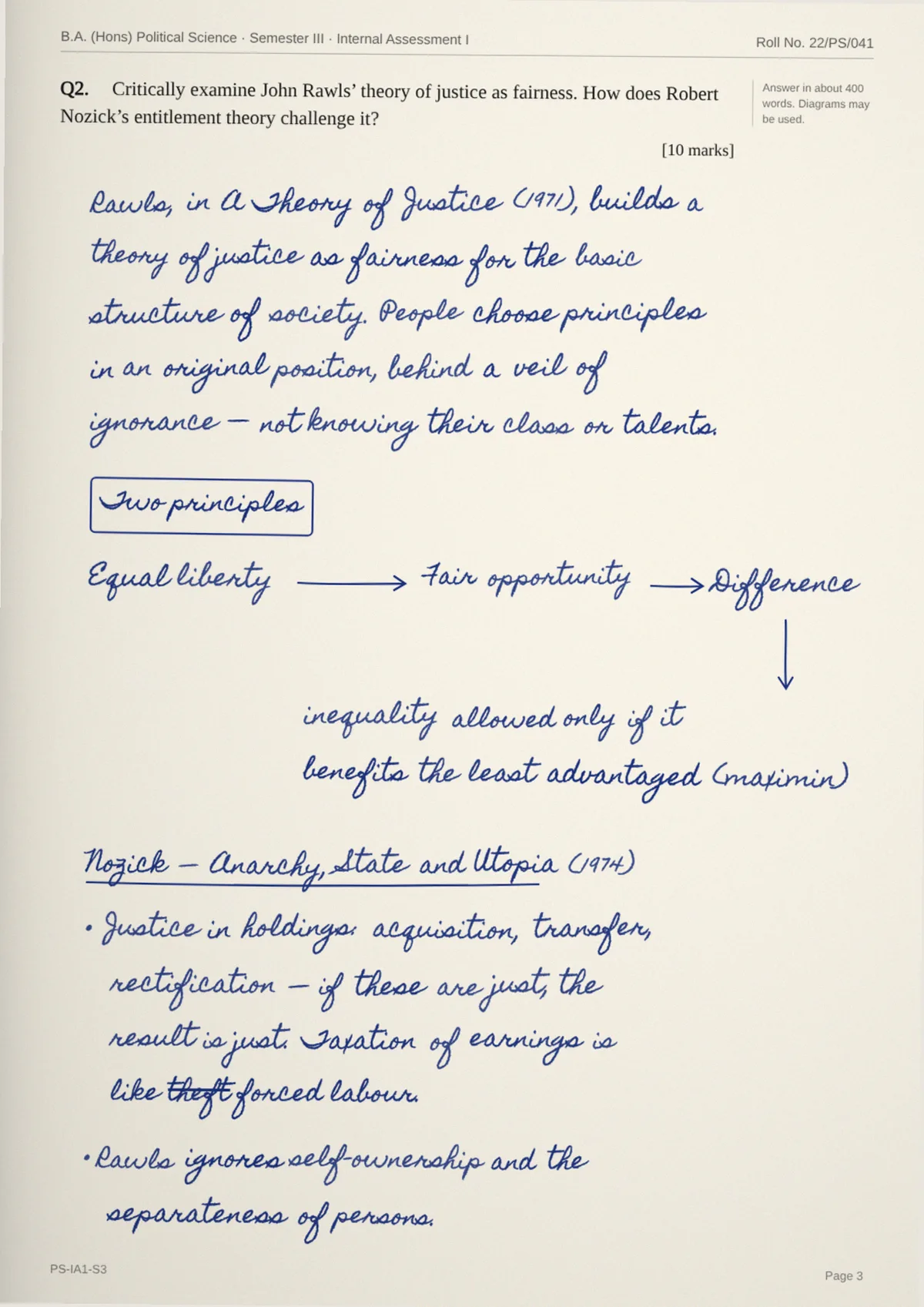
Scanned script · page 3 of 9Q2
A scanned handwritten answer page on Rawls and Nozick
clear framinglexical
priority?
good — cite
Wilt Chamberlain
Sandel / Sen critique missing
Q1 7/10Q2 6.5/10Q3 4/5Q4 11/15Q5 —/10

Q2 · Rawls & Nozick · 10 marks

“Critically examine” — needs both an account of Rawls and a weighed critique.

6.5/10
AwardedClass benchmark 8

Earned credit

  • Original position and veil of ignorance explained accurately.
  • Both principles, with the difference principle tied to maximin.
  • Nozick’s entitlement theory and the “forced labour” argument.

What held it back

  • No evaluation of who is right — “critically” is only half answered.
  • Communitarian (Sandel) or capability (Sen) critique missing.
  • Lexical priority of the principles not explained.

A top answer would add

Nozick’s Wilt Chamberlain example, a one-line verdict in the conclusion, and Sen’s critique that primary goods ignore what people can actually do with them.

Edit feedback Release to studentEvaluated in 2 min 41 s

Sample page and evaluation, shown as a teacher sees it before release.

Indiancollegesmarkcroresofanswersheetseveryyear.Studentsgetbackanumber,neverthereason.Weareheretochangethat—everyscript,readwithateacher’sfullattention.

How it works · four steps · ten-minute set-up

From booklet to report.

04 steps · 1 workflow · every subject

  1. 01

    Set the test

    Upload the question paper and your marking scheme. Questions, marks, sub-parts and choices are read for you.

    You
    Question paper + scheme
    You get
    A test ready in ten minutes
  2. 02

    Students upload

    Students photograph each page on their phone — or you bulk-upload scanned PDFs, matched by roll number.

    You
    Phone photos or scans
    You get
    One clean script per student
  3. 03

    AI evaluates

    It reads the handwriting, marks every answer against your scheme and writes specific feedback, live.

    You
    Nothing — watch it progress
    You get
    A full report in minutes
  4. 04

    You release

    Check the marks beside the scanned page, edit anything, then release. Nothing reaches a student before you do.

    You
    Review and edit
    You get
    Reports students act on
  5. One workflow, every subject you teach.

    Political ScienceEconomicsAccountancyPhysicsHistoryहिंदी साहित्यLawPsychologyUPSC GSNumericalsMCQEither / or

The report

Not a number. A report students act on.

Marks per question against a class benchmark, what earned credit, what was missing, what a top answer includes — and a plan for the next test.

Sample report · EvalDesk

Evaluation report

Paper 301 — Political Theory — Internal Assessment I

Political Science · B.A. (Hons) — Semester III

Candidate
Ananya (sample student)
Evaluated by
Course teacher
Date
12 Oct 2026
Standard
University assessment
Class benchmark
≈ 20 / 25
Band
Good — gap of ~2.5 marks to class benchmark

class benchmark

70%

Score

2.5 marks

Gap to class benchmark

Q1

Strongest answer

How to read the marks. Answers are marked against the teacher's marking scheme, the way a fair and experienced university examiner would.

01Scorecard

QThemeAwardedMax
Q1Positive and negative liberty45
Q2Rawls' justice as fairness6.510
Total17.525

Answer-writing skills — average across answers, out of 5

Content & accuracy4.0
Answers what was asked4.0
Structure4.0
Examples & application2.5
Diagrams, working & presentation3.5
Language & accuracy4.0

02Overall assessment

Ananya writes clear, well-organised answers and defines her terms before using them — the habit of a strong student.

The biggest gap is depth of critique: arguments are summarised accurately but rarely tested against a counter-view.

What is already working

  • Precise definitions
  • Logical structure with headings
  • Correct use of thinkers' names

What is holding back the score

  • Critiques stay at one line
  • Few contemporary examples

03Question by question

For each answer: what the question asked for, what earned credit, what was missing or wrong, and what a top-scoring answer would have included.

Q1

Positive and negative liberty

4/5

What the question asked. Define liberty and distinguish its two concepts with an example each.

Earned credit

  • Clear definition of liberty.
  • Berlin's distinction explained accurately.

Missing or wrong

  • The example for positive liberty is generic.

What a top-scoring answer would include

  • Use T.H. Green's idea of 'capacity' as the example of positive liberty.

Examiner’s margin remark

Crisp and correct — sharpen the second example.

Q2

Rawls' justice as fairness

6.5/10

What the question asked. Critically examine — explain the theory, then evaluate it with critiques and a reasoned judgement.

Earned credit

  • Original position and veil of ignorance explained well.
  • Both principles of justice stated correctly.

Missing or wrong

  • Critique limited to Nozick; communitarian and capability critiques absent.
  • No concluding judgement.

What a top-scoring answer would include

  • Add Sandel's communitarian critique and Sen's capability approach.
  • End with a one-paragraph judgement of your own.

Examiner’s margin remark

Good exposition. 'Critically' needs the other side — and your verdict.

05Before the next test

Habits for the next test

  • Underline the directive word before writing
  • Give every theory one critique and one example

Four-week plan

  1. 1

    Week 1

    Rewrite Q2 with two critiques and a conclusion.

Target for the next test: 20 / 25 — by adding critiques and a closing judgement.

Course teacher

Course teacher

The principles

Fast is easy. Fair is the point.

100%of reports are released by a teacherNothing reaches a student until a teacher has seen it. Every edit is kept beside the AI’s original.
6dimensions on every answerContent, the directive word, structure, current awareness, presentation and language — so students know exactly what to fix.
2languages, read and writtenHindi-medium scripts are read in Devanagari, and feedback can be written in English or हिंदी.
1marking scheme — yoursUniversity style, strict UPSC Mains, or your own instructions. The evaluator follows what you teach.

For colleges & institutes

Built for the way Indian colleges assess.

Internal assessments, mid-terms, practice papers and coaching mocks — set up once per test, used by every teacher and every section. We set it up with your faculty and train them in an hour.

Internal assessments

B.A., B.Com, B.Sc — any paper, any section

UPSC & coaching mocks

Strict Mains scale with topper benchmarks

Hindi-medium sections

Read and reported in हिंदी

Class analytics

Weakest questions and skills, per class

Questions

What colleges actually ask us.

Does this replace the teacher?

No. The AI drafts the evaluation; a teacher checks it beside the scanned script, edits anything, and decides when it is released. Colleges can choose to require review for every script.

How accurate is the marking?

It marks against your own question paper and marking scheme, so it follows what you teach. Every mark comes with the reasons — what earned credit and what was missing — so a teacher can verify it in seconds instead of re-reading the whole answer.

Can it read messy handwriting and Hindi?

Yes, it reads ordinary student handwriting in English and in Hindi (Devanagari), including diagrams and flowcharts. If a page is too faint to read it says so, rather than guessing.

Which subjects and exams does it work for?

Any written subject — humanities, commerce, sciences with numericals (method marks, not just the final answer), languages and law — plus multiple choice, sub-parts, ‘either/or’ and ‘attempt any five’. There is a strict UPSC Mains mode for coaching.

What happens to students’ scripts and data?

Each college’s data is kept separate and visible only to its own staff and the student concerned. Scripts are used only to produce that student’s evaluation.

What does it cost?

You start with 10 free scripts, no card needed. After that, colleges pay per term for a number of scripts — see pricing.

Try it with your next test.

Set-up takes ten minutes. Your first 10 scripts are on us.